There is a particular hush that settles over villages in Rajasthan once the monsoon clouds begin to thin out and Bhadrapada arrives. Fields are green, wells are full, and along with that comes an old, familiar anxiety that has shaped rural life for generations: snakes. It is during this stretch of the year, right when the rains bring both relief and risk, that communities across Rajasthan, Haryana, Punjab and parts of Uttar Pradesh turn their attention to Gogaji.
Gogaji, known by many as Goga Ji, Jaharveer Gogaji or Jahar Veer, is remembered as a warrior-saint of extraordinary courage, and folk memory holds him as a protector against snakebite and venom. Goga Navami 2026 falls at the tail end of the monsoon, and for those who follow the tradition, it is less a calendar date than a moment to renew an old promise of protection, one that has been passed down through oral stories, shrine visits and family customs for centuries.
Goga Navami 2026 Date and Tithi
Before getting into the story and the rituals, here is the essential detail readers usually search for first.
| Detail |
Date & Time |
| Goga Navami 2026 |
Saturday, September 5, 2026 |
| Navami Tithi Begins |
September 5, 2026 at 12:13 AM |
| Navami Tithi Ends |
September 5, 2026 at 9:53 PM |
Goga Navami falls on the Navami Tithi of the Krishna Paksha in Bhadrapada, the lunar fortnight associated with this observance. Devotees typically use the day for Goga Ji worship, offering prayers at home shrines or travelling to a Goga Than, a local shrine dedicated to him, to seek his blessings and protection for the year ahead.
Who is Gogaji?
Long before he became a name invoked in prayer, Gogaji is remembered in folk tradition as a real presence in the region around Dadrewa, a town in what is now Churu district of Rajasthan. According to legend, he was born into a Chauhan Rajput family and grew into a warrior whose bravery became the stuff of ballads sung by wandering minstrels for generations.
What sets Gogaji apart from other regional folk heroes, though, is his deep and unusual connection with serpents. Tradition holds that he had the ability to communicate with and command snakes, and this association became so central to his identity that, over time, he came to be worshipped primarily as a guardian against snakebite. He is also called Zahir Pir, a title meaning "the manifest saint," which points to how his following crossed religious lines rather early on.
It is worth being upfront here that much of what is known about Gogaji comes from oral legend, folk ballads and devotional retellings rather than documented history. That does not make the tradition any less meaningful. If anything, it is precisely because the story has been carried forward by ordinary people, generation after generation, that it still feels alive today.
The Story of Gogaji: The Legend Behind Goga Navami
The story, as it is usually told, begins with longing. Gogaji's mother, Bachal, is said to have been childless for years and prayed fervently for a son. According to the legend, her prayers were eventually answered through the blessings of Guru Gorakhnath, and Gogaji was born in Dadrewa.
From early childhood, the stories say, he showed a strange affinity for snakes, an ease around them that unsettled and fascinated people in equal measure. As he grew older, this connection deepened rather than faded. He trained as a warrior and earned a reputation not just for his skill in battle but for his compassion, particularly his willingness to step in and heal or protect people from snakebite, something that made him deeply loved among farmers and herders who lived closest to that danger.
It was this reputation that eventually earned him the title Jahar Veer, roughly "the brave one who conquers poison." Over the years, his fame as both a warrior and a healer spread well beyond Dadrewa.
The legend concludes with his samadhi at Gogamedi, a place that would go on to become the spiritual centre of his worship. Gogamedi is not just a historical footnote in the story; it remains the site of the large annual Gogamedi Mela, where thousands gather even today to honour him.
Why is Goga Navami Celebrated?
Goga Navami is in essence a very practical, very human fear: the fear of snakebite, especially during the monsoon months when the ground is wet and snakes are more active around homes and fields. Devotees pray to Gogaji for protection from venom, and that naturally extends to the safety of children, families and livestock.
In many rural households, cattle represent both livelihood and security, so prayers on this day often include a request for the safety of animals as much as people. There is also a strand of belief connecting Gogaji with fertility and childbirth, with some families praying to him for the safe birth and protection of children. None of this is presented as doctrine; it is simply what has been passed down as tradition, region by region, family by family. The Goga Navami vrat, observed by many devotees on this day, is one expression of that ongoing faith in his protection.
Goga Navami Puja Vidhi
Practices vary from household to household and region to region, but there is a broad, familiar rhythm to how Goga Navami puja is observed.
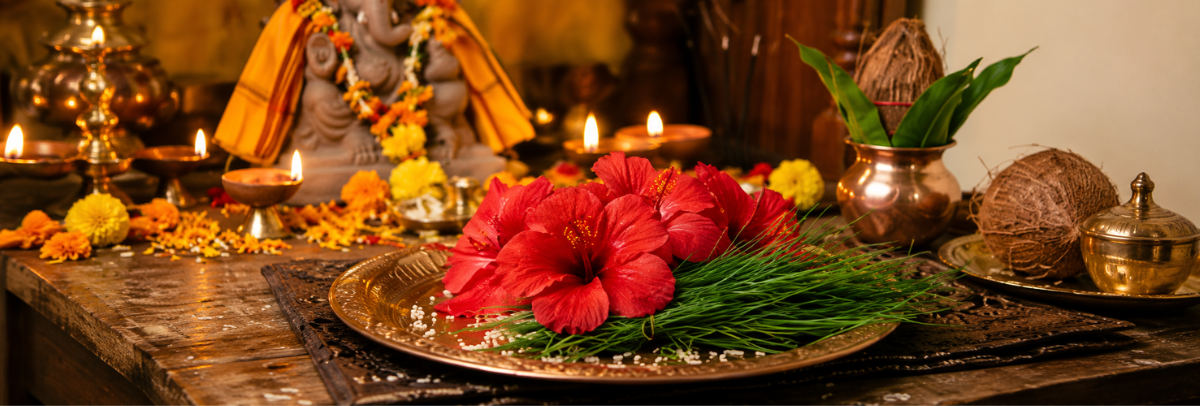
Most families begin by cleaning the home and setting up a simple space for worship. Many then visit a Goga Than or a local shrine associated with Gogaji, carrying offerings such as milk, kheer, churma and flowers, along with incense. Prayers are offered to Gogaji himself and, in many places, to the snake deity associated with him.
One of the most visible traditions is the carrying of the nishan, a decorated flag linked to Gogaji, which devotees may bring along during shrine visits or processions. Bhajans are sung, and in places with a strong local following, processions wind through streets accompanied by drums and devotional singing. At some shrines, devotees receive bhabhoot, a sacred ash believed to carry protective blessings, though this custom is not universal and depends on the particular shrine's tradition.
Not every family follows every one of these steps, and that is entirely normal. Goga Navami puja is shaped as much by local custom as by any fixed set of rules.
Goga Navami Vrat and Traditional Observances
For those who observe the Goga Navami vrat, the fast is generally kept as an act of devotion, a way of asking for the protection and wellbeing of the family. Women, in particular, often observe this vrat with prayers centred on the safety of their children and the health of the household.
Food practices during the fast differ quite a bit from one region to another, and even between families in the same village. Some keep a strict fast through the day, breaking it only after visiting a shrine or completing the evening puja, while others follow lighter observances built around specific foods. What tends to stay consistent, regardless of the exact form the fast takes, is a visit to a temple or shrine and a sense of shared, communal worship, since Goga Navami is rarely observed in isolation.
Goga Ji Worship and the Tradition of Nishan
Ask anyone familiar with Goga Navami what image comes to mind first, and there is a good chance they will mention the nishan. This is the flag, often in shades of blue, that has become almost synonymous with Gogaji himself.
Devotees carry these colourful flags as an offering and as a visible marker of devotion during Goga Ji worship. Processions carrying the nishan are typically accompanied by the steady beat of drums, along with bhajans sung by groups of devotees making their way to a shrine. There is a strong communal character to this practice. Groups often travel together from villages and towns to shrines associated with Gogaji, turning what could be a solitary act of prayer into a shared, public expression of faith.
Gogamedi: The Sacred Place of Gogaji
If there is one place that captures the spirit of Goga Navami most completely, it is Gogamedi in Rajasthan. This is where, according to legend, Gogaji took samadhi, and it has since grown into the most significant pilgrimage site connected with him.
The atmosphere at Gogamedi during the annual Gogamedi Mela is difficult to describe without seeing it. Devotees arrive from across the region, many carrying nishans, filling the space with the sound of bhajans and the steady movement of processions. It is less a tourist destination and more a living centre of faith, where the story of Gogaji feels present rather than merely remembered.
Goga Navami and the Tradition of Communal Harmony
One of the quieter but more remarkable aspects of Gogaji's legacy is how his worship has never been confined to a single community. He is revered by both Hindu and Muslim devotees, and the different names attached to him reflect this shared devotion. Where Hindu tradition speaks of Goga Ji or Jahar Veer, Muslim devotees have long referred to him as Zahir Pir.
This overlap is not a modern development. It reflects centuries of shared regional culture, where faith in a protector against snakebite and misfortune transcended religious boundaries. Goga Navami, in that sense, continues to stand as a quiet but meaningful example of how folk devotion in this part of India has historically brought communities together rather than dividing them.
Religious Significance of Goga Navami
Taken as a whole, Goga Navami endures because it speaks to concerns that have never really gone away. Protection from snakebite remains a genuine, practical worry in rural and semi-rural life, particularly during the monsoon. Families continue to pray for the safety of their children, for successful childbirth, and for the wellbeing of the cattle and livestock that so many households still depend on.
Beyond these individual concerns, though, the festival carries a broader significance. It draws people out of their homes and into shared spaces of worship, whether at a small village Goga Than or the grand gathering at Gogamedi. In doing so, it keeps alive a distinctly regional form of devotion, one rooted in Rajasthan's folk traditions rather than mainstream religious texts. That, perhaps, is what makes Gogaji's story so resilient. It survives not because it is written down in scripture, but because it continues to be lived, sung and carried forward by ordinary people, year after year.
FAQs
Q1. When is Goga Navami 2026?
Ans. Goga Navami 2026 falls on Saturday, September 5, 2026, with the Navami Tithi running from 12:13 AM to 9:53 PM that day.
Q2. Who is Goga Ji and why is he worshipped?
Ans. Goga Ji, also known as Jaharveer Gogaji, is a folk warrior-saint from Dadrewa in Rajasthan, revered chiefly as a protector against snakebite and venom, and more broadly as a guardian of families and livestock.
Q3. How is Goga Navami puja performed?
Ans. Devotees typically clean their homes, visit a Goga Than or local shrine, offer milk, kheer, churma and flowers, carry the nishan flag, and sing bhajans, though exact practices vary by region and family.
Q4. What is the significance of the Goga Navami vrat?
Ans. The vrat is observed as an act of devotion, with prayers for family protection, safe childbirth and the wellbeing of children, and its exact form differs from household to household.
Q5. Why is Gogamedi important during Goga Navami?
Ans. Gogamedi in Rajasthan is believed to be the site of Gogaji's samadhi and hosts the annual Gogamedi Mela, making it the most significant pilgrimage destination associated with his worship.