Walk through any South Indian neighbourhood on the Friday before Shravana Purnima and you'll notice it straight away. Doorsteps get a fresh coat of kolam powder, someone's grandmother is shouting instructions about how many mango leaves go on the kalash, and there's that unmistakable smell of turmeric mixed with jaggery drifting out of half the kitchens on the street. That's Varalakshmi Vrat, and this year it lands on Friday, 28 August 2026.
For families in Karnataka, Andhra Pradesh, Telangana and Tamil Nadu, this isn't just another date on the religious calendar. It's arguably one of the most emotionally loaded festivals of the year, because unlike a lot of pujas that focus on individual spiritual growth, this one is performed entirely for the family's sake — for their health, their prosperity, and simply for things to go well at home. Married women usually take on the role of chief observer, though in most households everyone pitches in somewhere, whether that's polishing the kalash, arranging flowers, or just sitting quietly through the katha at the end.
What is Varalakshmi Vrat, Really?
Start with the name. "Vara" means boon, so Varalakshmi is Lakshmi in her most generous, boon-granting avatar. Devotees believe that worshipping her on this one day brings the combined blessings of all eight forms of the goddess, the Ashta Lakshmi — wealth, grain, courage, victory, patience, children, wisdom, the lot. That's partly why the day carries so much weight; it's treated almost like a shortcut to appeasing every aspect of the goddess at once.
Fridays within Shravana Shukla Paksha are already considered special for Lakshmi worship, since the entire month of Shravana is thought to be close to her heart. Varalakshmi Vrat lands specifically on the last such Friday before the full moon (Shravana Purnima), when the moon is waxing and, according to tradition, devotional acts carry a bit more punch.
While the festival's strongest roots are in Karnataka, Andhra Pradesh and Telangana, Tamil Nadu observes it with just as much enthusiasm, and it's slowly found a home among devotee communities in Maharashtra too, helped along by migration and by temples that now welcome pilgrims from well beyond their home states.
Varalakshmi Vrat 2026: Date & Puja Timings
Per the Drik Panchang, Varalakshmi Vratam 2026 falls on Friday, 28 August 2026 — the final Friday of Shravana Shukla Paksha, right before Shravana Purnima. Most Panchangs across India will list this as the date.
That said, there's a regional wrinkle worth flagging. Some communities, particularly ones following different calendar traditions in North and South India, mark the vrat a week earlier, on Friday, 21 August 2026. Neither is "wrong" — it comes down to how a particular region calculates the Shravana month. If you're unsure which one applies to you, the safest bet is to go with whatever your family has always followed, or ask a family elder or the local priest.
Here's the puja muhurat breakdown for 28 August 2026:
| Puja Muhurat |
Time |
| Morning (Simha Lagna) |
5:57 AM – 7:29 AM |
| Afternoon (Vrishchika Lagna) |
12:05 PM – 2:23 PM |
| Evening (Kumbha Lagna – Preferred Pradosh Muhurat) |
6:09 PM – 7:37 PM |
| Midnight (Vrishabha Lagna) |
10:37 PM – 12:33 AM (29 August) |
Of these four, the evening slot during Pradosh Kaal is the one most families lean towards. Pradosh Kaal — that stretch covering the last bit of daylight and the first shade of dusk — is thought to be spiritually charged precisely because it sits at the boundary between day and night. There's also a very practical reason it's popular: it gives working women and joint families time to finish the day's chores, gather calmly in the evening, and get through the puja, katha and aarti without racing against the clock.
The Story Behind Varalakshmi Vrat
The tale usually traced back to this vrat is set in the city of Magadha, where a woman named Charumathi lived with her husband's family. She wasn't wealthy or particularly influential, but she was known around town for one thing: her quiet, steady devotion to Goddess Lakshmi, and the patient, uncomplaining way she went about her duties at home, even on the harder days.
One night, the story goes, Lakshmi appeared to her in a dream — dressed in gold, glowing faintly, the way goddesses tend to appear in these stories. She told Charumathi she was pleased with her devotion and instructed her to observe a special vrat on the Friday just before Shravana Purnima. Anyone who performed it sincerely, the goddess promised, would see their family blessed with prosperity, good health and happiness.
Charumathi woke up shaken, in a good way, and rushed to tell her mother-in-law and the other women in the household. Word travelled fast, as it does in small towns, and by the time the appointed Friday rolled around, women from across the neighbourhood had turned up at her home wanting to take part. They scrubbed their houses clean, set up the kalash exactly as instructed, and worshipped together with full sincerity.
What happened next is where the story gets its shine, quite literally. The women who'd observed the vrat began noticing their bangles looking like solid gold, their ordinary brass vessels taking on the gleam of silver. A general sense of ease crept into their homes. Charumathi's own family, in particular, is said to have prospered for years afterwards, enjoying long life and harmony. It's this story that gets read out every year during the vrat, and it's probably why so many women still approach the day with the same simple, uncomplicated faith Charumathi is said to have had.
Step-by-Step Kalash Sthapana
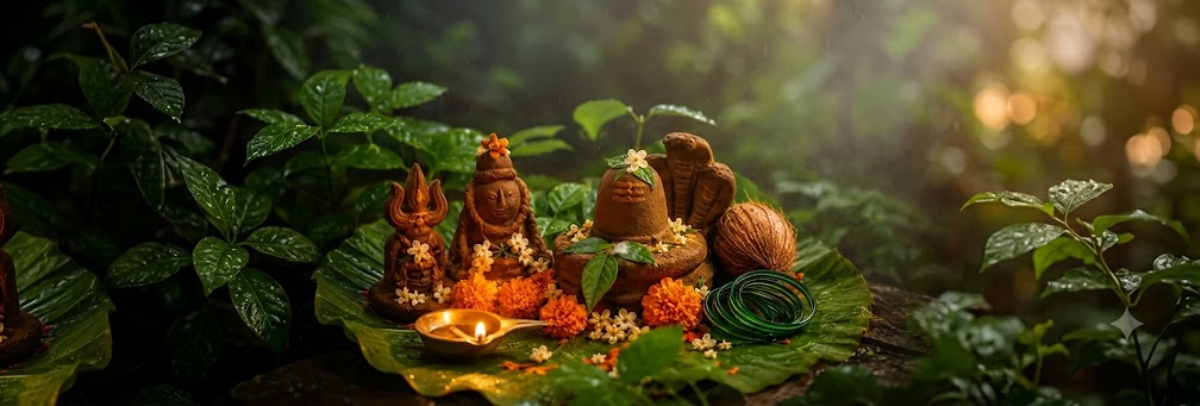
Setting up the kalash properly matters a great deal to most families, and the steps tend to go like this:
- Wipe down a wooden plank and set it in the puja space.
- Spread a layer of raw rice over it as a base.
- Clean the Kalash — brass, copper or silver, whatever the family uses — until it's spotless.
- Apply turmeric paste and kumkum in bands around its neck.
- Fill it with sacred water, a bit of rice, a coin, a betel nut and a pinch of turmeric.
- Arrange five or nine fresh mango leaves around the rim, facing outward.
- Set a turmeric-coated coconut on top, pointed end up.
- Give the coconut a face — a silver or gold foil mask of Goddess Lakshmi works well here.
- Drape the whole thing in a fresh silk cloth and finish with jewellery, garlands and flowers.
Complete Varalakshmi Puja Vidhi
The puja moves through a sequence that's stayed more or less the same for generations, and each part of it has a reason behind it, even if that reason isn't always spelled out.
Most families start early, in Brahma Muhurta, before the sun's properly up, since this window is considered the most spiritually receptive part of the day. The house gets a thorough clean first — cleanliness here isn't just tidiness, it's treated as a way of signalling readiness to receive the goddess. After a bath and getting dressed in traditional clothes, usually a fresh saree, the puja opens with Ganesha Puja, clearing obstacles before anything else begins, followed by Sankalpam, where the devotee formally states her intention and purpose for the day.
Avahana comes next, inviting the goddess into the kalash. Panchamrit — milk, curd, honey, ghee and sugar mixed together — is offered as a gesture of purity and sweetness. Then come the Lakshmi Stotras and hymns, along with flowers and Naivedyam, the food prepared specially for the day.
One of the more touching rituals is Dorakabandhana — tying a yellow thread with nine knots around the wrist, each knot said to represent one aspect of the goddess's blessings. The Varalakshmi Vrat Katha is read out around this point, aarti follows, and the whole thing wraps up with Tamboolam, where betel leaves, coconuts, fruits and small gifts are exchanged among the women present as a way of sharing blessings.
Spiritual Benefits, According to Tradition
Devotees hold that worshipping Varalakshmi draws in the blessings of all the Ashta Lakshmi forms — Dhana Lakshmi for wealth, Dhanya Lakshmi for grain and nourishment, Santana Lakshmi for children, Vijaya Lakshmi for success, Dhairya Lakshmi for courage, and Ayush for a long life. Family harmony, prosperity, good health, protection and general peace of mind are also commonly associated with sincere observance. Worth saying plainly: these are matters of faith passed down through tradition, not claims that can be verified, and it's best to approach them that way.
Temples Associated with Goddess Lakshmi
- Mahalakshmi Temple, Kolhapur: This temple in Maharashtra is one of the revered Shakti Peethas, and it holds a special place for devotees across the state. During Lakshmi-focused festivals, including Varalakshmi Vratham, footfall rises considerably, with pilgrims travelling in specifically to seek blessings from the goddess in what's considered one of her oldest, most powerful forms.
- Ashtalakshmi Temple, Chennai: Set along Chennai's coastline, this temple is unusual in that it houses all eight forms of Goddess Lakshmi under one roof. The setting itself is calm — sea breeze, open skies — and during Varalakshmi Vratham, many devotees consider a visit here the most efficient way to honour every aspect of the goddess in a single trip.
A Few Practical Tips for Observing the Vrat at Home
- Get your puja items sorted a day ahead so you're not scrambling.
- Fresh flowers over artificial ones, where you can manage it.
- Make sure the Kalash is properly stable before you start decorating it.
- Keep the puja area clean throughout, not just before you begin.
- Stick to what your own family has always done rather than copying someone else's version.
- If your health or age makes a full fast difficult, adjust it — there's no rule against that.
- Some form of charity on the day, however small, is generally considered a good addition.
Wrapping Up
Varalakshmi Vrat 2026 falls on Friday, 28 August, though some households will mark it a week earlier on 21 August depending on their regional calendar. Whichever date applies to your family, the heart of the day stays the same — a carefully assembled Kalash Sthapana, a puja carried out with sincerity, and a story that gets retold so nobody forgets why any of it matters. Strip away the ritual and what's left is gratitude, patience and hope for the people you love, values that outlast any single Friday in Shravana. However you choose to observe it, doing so with genuine devotion and in keeping with your family's own customs is really what counts.
FAQ's
Q1. When is Varalakshmi Vrat 2026?
Ans: It falls on Friday, 28 August 2026, according to the Drik Panchang, though some communities following different regional calendars observe it on Friday, 21 August instead.
Q2. Why is Kalash Sthapana important during Varalakshmi Vrat?
Ans: The Kalash is believed to act as a seat for Goddess Lakshmi during the puja, so setting it up carefully with sacred water, rice, coins and mango leaves is seen as key to inviting her presence into the home.
Q3. Who can observe Varalakshmi Vratham?
Ans: Married women are the traditional observers, though unmarried women and other family members often join in the preparations and prayers as well.
Q4. What offerings are made to Goddess Lakshmi during this vrat?
Ans: Typical offerings include Panchamrit, fresh flowers, fruits, Naivedyam, turmeric, kumkum, and the yellow sacred thread tied during Dorakabandhana.
Q5. Which temples are associated with Goddess Lakshmi during Varalakshmi Vrat?
Ans: The Mahalakshmi Temple in Kolhapur and the Ashtalakshmi Temple in Chennai are among the most visited during this period, each carrying its own regional and spiritual significance.