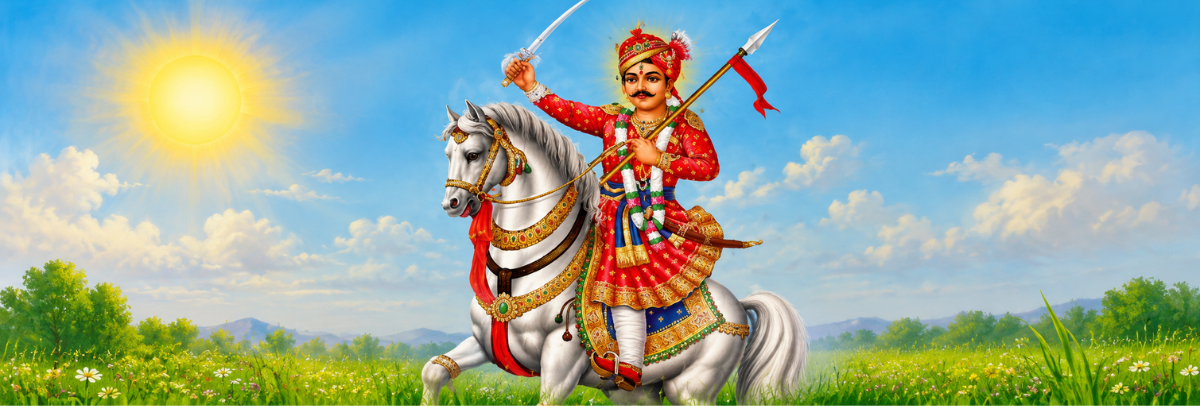
In the days leading up to Radha Ashtami, Barsana begins to feel like a town holding its breath. The lanes around the Shri Ladli Ji Maharaj Temple fill with marigold garlands, the smell of incense drifts further than usual, and by evening the bhajans from the temple courtyard carry across the rooftops. Vrindavan, a short drive away, settles into its own version of the same anticipation — swings dressed in flowers, deities in fresh silk, and a quiet sense that something important is about to be remembered rather than simply marked on a calendar.
That something is the appearance of Shri Radha Rani. Radha Ashtami falls on the Ashtami Tithi of Shukla Paksha in the Hindu month of Bhadrapada, and for devotees across the Radha-Krishna tradition, it is one of the most tender festivals of the year — not loud in the way some festivals are, but deeply felt. It sits roughly a fortnight after Janmashtami, almost as if the calendar itself insists that Krishna's story cannot be told without Radha's.
Here's everything you need to know about Radha Ashtami 2026 — the exact date and timings, the story behind the day, and how the vrat and puja are traditionally observed.
When Is Radha Ashtami 2026?
Radha Ashtami 2026 falls on Saturday, 19 September 2026, during the Shukla Paksha of Bhadrapada month.
The Ashtami Tithi actually begins the previous afternoon and extends into the 19th, which is why the exact timings matter for anyone planning their vrat and puja:
- Ashtami Tithi begins: 1:00 PM on 18 September 2026
- Ashtami Tithi ends: 3:26 PM on 19 September 2026
- Madhyahna Puja Muhurat: 11:01 AM to 1:28 PM (some regional Panchangs extend this window to around 1:45 PM)
|
Occasion
|
Date/Timing
|
|
Radha Ashtami 2026
|
Saturday, 19 September
|
|
Ashtami Tithi Begins
|
1:00 PM, 18 September
|
|
Ashtami Tithi Ends
|
3:26 PM, 19 September
|
|
Madhyahna Puja Muhurat
|
11:01 AM – 1:28 PM*
|
*Regional Panchang calculations vary slightly, so some almanacs list the Madhyahna window running a little later, closer to 1:45 PM. It's worth checking your local Panchang if you follow one closely.
The Madhyahna period — roughly the midday hours — is treated as the heart of the day's worship, because Radha Rani is traditionally believed to have appeared around noon. Whatever else a devotee's day looks like, the main puja is generally timed to fall within this window rather than at the start or end of the Tithi.
Why Is Radha Ashtami Celebrated?
The story goes back to Barsana, a town in the Braj region not far from Mathura, where King Vrishabhanu and Queen Kirtida are, according to tradition, said to have found Radha. She grew up in Barsana, and her life became inseparable from Krishna's — the two are remembered together so consistently in devotional literature and art that it's hard to think of one without the other.
Within Vaishnava tradition, Radha is regarded as Hladini Shakti — the divine pleasure potency associated with Krishna, representing love in its most complete and selfless form. This isn't a minor theological footnote; it's central to why devotees mark her appearance with such warmth. Her devotion to Krishna is held up as a model of bhakti that asks for nothing in return — not proximity, not recognition, just love itself. That's part of why Radha Ashtami tends to feel less like a grand spectacle and more like an intimate, heartfelt occasion, even amid the crowds in Barsana.
Radha Ashtami and the Divine Bond of Radha and Krishna
Ask a devotee in Vrindavan why Radha's birthday matters as much as Krishna's, and you'll likely hear some version of the same answer: the two are not really separate stories. In much of Vaishnava tradition, Radha and Krishna are understood as eternally united, and devotion directed towards Radha is seen as a path towards Krishna-prema — pure, unconditional love for Krishna, rather than devotion built on request or reward.
Texts such as the Srimad Bhagavatam and the Brahmavaivarta Purana are often cited in this context, though it's worth noting that interpretations of Radha's role vary between different Vaishnava schools and lineages. What's shared across most of them is the sense that approaching Krishna through Radha is considered, within this devotional worldview, a gentler and more complete way to understand divine love.
Radha Ashtami Vrat 2026
Fasting on Radha Ashtami looks different depending on who you ask, and that's fine — there's no single "correct" way to observe it. Broadly, three approaches are common:
- A half-day vrat, broken after the midday puja and bhog offering.
- A full-day vrat, continued through the day.
- A stricter Nirjala vrat, without food or water, followed by some devotees who are able to undertake it.
Many households begin the day with an early bath, followed by a sankalp — a simple, spoken intention to observe the vrat and puja that day. Foods commonly associated with the fast include fruits, milk, and makhan-mishri (butter and sugar crystals, a nod to Krishna's own fondness for butter), along with other foods considered suitable for vrat. Some devotees also avoid grains, salt, and foods traditionally regarded as tamsik during the fasting period, though this again depends heavily on family and regional custom.
|
Vrat Practice
|
Traditional Observance
|
|
Half-day vrat
|
Broken after midday puja and bhog
|
|
Full-day vrat
|
Continued through the day
|
|
Nirjala vrat
|
No food or water; observed by some devotees
|
|
Vrat foods
|
Fruits, milk, makhan-mishri and suitable fasting foods
|
If you have dietary needs, a medical condition, or any other practical constraint, it's worth following guidance suited to your own situation rather than adopting a demanding fast simply because it's traditional elsewhere. The spirit of the vrat matters more than its severity.
Radha Ashtami Puja Vidhi
Home puja on Radha Ashtami tends to follow a fairly natural sequence, though temple worship — especially in Braj — is often more elaborate. A simplified version that many households follow looks something like this:
- Morning preparation — waking early, bathing, and wearing clean clothes before anything else.
- Sankalp — a short vow or intention to observe the day's vrat and puja.
- Altar preparation — cleaning the worship space and setting out images or idols of Radha Rani and Lord Krishna together.
- Abhishekam — bathing the deities, traditionally with milk, curd, honey, ghee and Ganga water.
- Shringar — dressing and adorning the deities with fresh clothes, sandalwood paste, flowers, lotus petals and tulsi leaves.
- Madhyahna puja — the principal worship, performed during the midday muhurat.
- Bhog — offering food to the deities, ranging from an elaborate Chappan Bhog (fifty-six dishes) in temples to simpler offerings of makhan-mishri, rabri, sweets and fruit at home.
- Mantra and bhajan — reciting prayers dedicated to Radha and singing devotional bhajans.
- Jhulan — decorating a small cradle or swing, a tradition closely associated with Braj temples in particular.
- Aarti and prasad — closing the puja with aarti, followed by sharing the prasad.
Not every household performs every one of these steps, and that's entirely normal — temple worship and home worship have always looked somewhat different from each other. What matters more than following every ritual precisely is the sincerity behind it.
Radha Ashtami Mantras & Devotional Practices
For those wanting to include chanting as part of their day, one of the most widely recited mantras is: "Om Hreem Shri Radhikaye Namah".
Alongside this, many devotees turn to the Radha Gayatri mantra, recite the Sri Radhikashtakam, sing Radha-Krishna bhajans, or simply spend part of the day listening to katha (devotional storytelling) related to Radha's life. None of this needs to be elaborate — even a quiet half hour of chanting or listening to bhajans is, for many households, enough to mark the day meaningfully.
Radha Ashtami Celebrations in Barsana and Vrindavan
If you can be in Braj for Radha Ashtami, the atmosphere is worth experiencing at least once. Barsana, as Radha's traditional birthplace, becomes the natural centre of celebration — temples are freshly decorated, bhajans continue through the day, and special puja and offerings are made in her honour. Vrindavan, close by, carries its own version of the same devotion, with temples adorned and jhulan decorations swaying gently through the crowds of devotees seeking darshan.
There's a particular energy to Braj during this period that's hard to put into words unless you've stood in it — a mix of devotion, music and genuine joy that doesn't feel staged for visitors, even though plenty of travellers do make the trip specifically for this. For many devotees, simply being present in Barsana on this day, even without doing anything elaborate, feels like its own form of worship.
Radha Ashtami, Mahalakshmi Vrat & Durva Ashtami
Depending on the year, Radha Ashtami can fall close to other observances such as Mahalakshmi Vrat and Durva Ashtami. It's worth being clear that these are separate traditions, each with their own rituals and significance — they are not alternative names for Radha Ashtami, nor do they share identical rites, even when their dates happen to sit near one another on the calendar. If you follow either of these observances alongside Radha Ashtami, it's best to treat them according to their own customs rather than assuming they overlap.
Religious Significance of Radha Ashtami
At its centre, Radha Ashtami is a celebration of Radha Rani's appearance — but it carries more than that. It's a day devoted to bhakti itself, to the relationship between Radha and Krishna, and to the idea, held within Vaishnava tradition, that devotion to Krishna finds its fullest expression through devotion to Radha. The concept of Hladini Shakti — Radha as the embodiment of divine bliss and love — sits at the heart of this understanding, as does the pursuit of Krishna-prema that so many devotees speak of on this day.
These are, of course, interpretations rooted in a particular devotional and theological tradition, and within Vaishnavism itself there's room for different schools to frame Radha's significance slightly differently. What remains consistent is the reverence with which she's remembered.
Conclusion
By evening on Radha Ashtami, the swings in Vrindavan are still gently moving, the bhajans in Barsana haven't quite stopped, and somewhere a prasad plate is still being passed around a family altar. Whether the day is spent in the middle of that atmosphere in Braj or quietly at home with a simple puja, the thread running through it is the same — love, remembered and renewed, between Radha and Krishna. Radha Ashtami 2026, falling on 19 September, is really an invitation to sit with that idea for a day, and perhaps carry a little of it forward.
FAQs
Q1. When is Radha Ashtami in 2026?
Radha Ashtami 2026 falls on Saturday, 19 September 2026, during the Ashtami Tithi of Shukla Paksha in Bhadrapada month.
Q2. What is the Madhyahna puja time for Radha Ashtami 2026?
The Madhyahna Puja Muhurat is generally listed as 11:01 AM to 1:28 PM, though some regional Panchangs extend this window to around 1:45 PM.
Q3. What is the Radha Ashtami vrat?
It's a fast observed in honour of Radha Rani's appearance, taken as a half-day fast broken after midday puja, a full-day fast, or a stricter Nirjala fast, depending on family and regional tradition.
Q4. How is Radha Ashtami puja performed at home?
A typical home puja includes cleaning the altar, offering abhishekam and shringar to images of Radha and Krishna, performing the main worship during the Madhyahna muhurat, offering bhog, and concluding with aarti and prasad.
Q5. Why is Radha Ashtami celebrated?
It marks the appearance of Radha Rani in Barsana and celebrates her eternal bond with Krishna, seen within Vaishnava tradition as the embodiment of pure devotion and divine love.