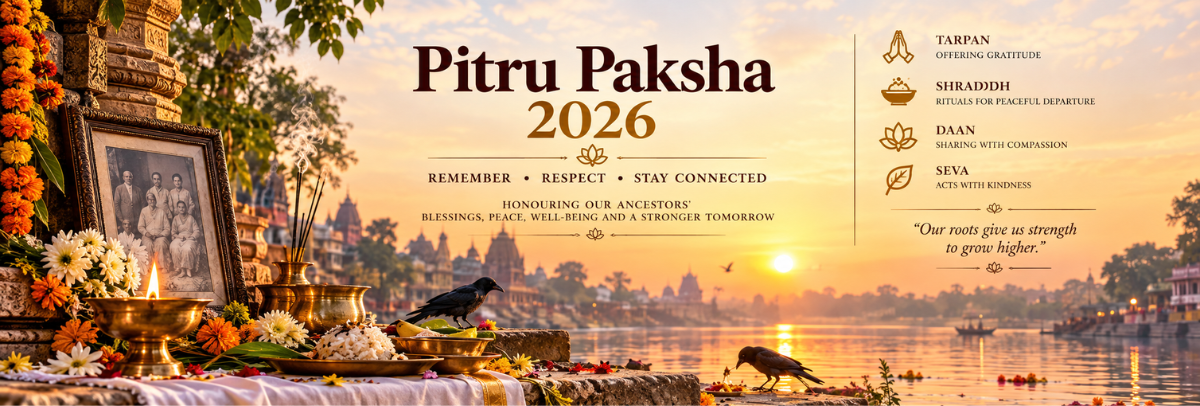
There is a particular quiet that settles over a household during Pitru Paksha. A framed photograph is dusted and set a little more prominently on a shelf. A steel or copper vessel is filled with water, black sesame seeds are measured out into a small bowl, and someone in the family — usually facing south, usually in the early afternoon — pours water slowly between cupped hands while murmuring the names of people who are no longer there to hear them. It is not a loud or theatrical observance. It is closer to a long, unhurried act of remembering.
Pitru Paksha is the fortnight in the Hindu calendar set aside for exactly this: honouring departed ancestors through Shraddha, Tarpan, Pind Daan and small acts of charity. It is not treated as a single ceremony performed once and forgotten, but as a sequence of days, each tied to a specific lunar date, on which different ancestors are traditionally remembered according to the tithi on which they passed away.
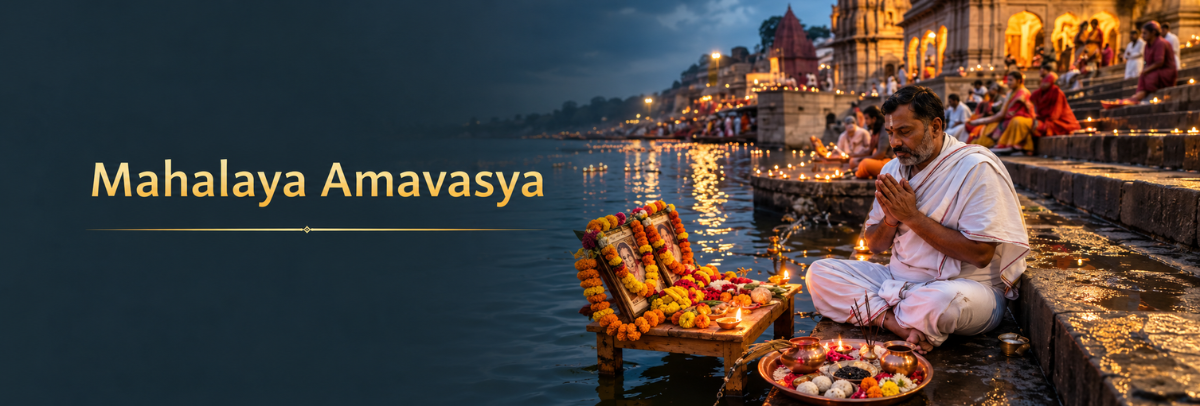
In 2026, Pitru Paksha begins on Saturday, 26 September and closes on Saturday, 10 October, the day of Sarva Pitru Amavasya, also known as Mahalaya Amavasya. Because the period is governed by the lunar calendar rather than fixed weekday dates, families who want to observe Shraddha on the correct day for a specific ancestor need to know exactly how this year's tithi calendar falls — which is the practical heart of this article.
Pitru Paksha 2026: Start Date, End Date & Duration
Pitru Paksha falls during the Krishna Paksha (the waning lunar fortnight) of the Hindu month of Bhadrapada, immediately before the arrival of Navratri. This year, the observance runs across sixteen days:
- Start: Saturday, 26 September 2026 — Purnima Shraddha
- End: Saturday, 10 October 2026 — Sarva Pitru Amavasya
It's worth being upfront about one thing: not every regional panchang agrees on the exact opening date. Some traditions count Purnima Shraddha, on 26 September, as the first day of the fortnight, while others begin the sequence a day later with Pratipada Shraddha on 27 September. Both readings are recognised by different family and regional customs, and the small variation comes down to how a particular tithi is reckoned rather than any real disagreement about the period itself. If your family follows a specific panchang or a family priest's guidance, it's worth confirming the exact start date with them — the dates set out here follow the sequence beginning with Purnima Shraddha on 26 September.
What doesn't vary is the underlying logic of the calendar. Shraddha is traditionally performed not on whichever Gregorian date happens to suit the family, but on the lunar tithi that corresponds to the day an ancestor passed away. This is why a printed calendar matters so much during these two weeks — it tells a family which day, within the fortnight, belongs to their father, their grandmother, or an aunt who died many years ago.
| Detail |
Date |
| Pitru Paksha Start |
26 September 2026 |
| Purnima Shraddha |
26 September 2026 |
| Pitru Paksha End |
10 October 2026 |
| Sarva Pitru Amavasya / Mahalaya Amavasya |
10 October 2026 |
Pitru Paksha Shraddha Dates 2026: Complete Tithi Calendar
Here is the full sequence of Shraddha tithis for 2026, which forms the practical reference most people are searching for when they look up this period:
| Shraddha Tithi |
Date in 2026 |
| Purnima Shraddha |
26 September |
| Pratipada Shraddha |
27 September |
| Dwitiya Shraddha |
28 September |
| Tritiya Shraddha / Maha Bharani |
29 September |
| Chaturthi Shraddha |
30 September |
| Panchami Shraddha |
1 October |
| Sasthi Shraddha |
2 October |
| Saptami Shraddha |
3 October |
| Ashtami Shraddha / Avidhava Navami |
4 October |
| Navami Shraddha |
5 October |
| Dashami Shraddha |
6 October |
| Ekadashi Shraddha |
7 October |
| Dwadashi Shraddha |
8 October |
| Trayodashi / Chaturdashi Shraddha |
9 October |
| Sarva Pitru Amavasya / Mahalaya Amavasya |
10 October |
The way to use this table is simple in principle, even if it takes a moment of thought in practice: find the tithi on which your ancestor died, and that is, traditionally, the day within Pitru Paksha on which their Shraddha is performed. A grandfather who passed on Ashtami, for instance, would traditionally be remembered on 4 October this year.
Sarva Pitru Amavasya deserves a little more attention than the rest of the calendar, because it isn't tied to one ancestor's tithi at all. It is traditionally observed for every ancestor in the family whose exact death tithi is unknown, has been forgotten over the generations, or for whom Shraddha could not be performed on the correct day earlier in the fortnight. In many households, it becomes the day when the whole lineage — known and unknown — is remembered together, which is part of why it is widely regarded as the most significant date of the entire period.
What Is Shraddha? Understanding the Tradition
At its centre, Shraddha is an act of remembrance performed with faith — the word itself is often linked to shraddha, meaning faith or reverence. It rests on the idea of Pitru Rin, one of three traditional debts a person is said to carry through life, alongside debts to the divine and to one's teachers. Pitru Rin is the debt owed to one's ancestors, for the life, the lineage and the opportunities passed down through generations.
Shraddha, in this understanding, is not a transaction or a request for a particular outcome. It is a way of acknowledging that debt — of pausing once a year to say, in effect, that the people who came before have not been forgotten, and that the family continues to carry their memory forward. Different traditions and regional customs shape exactly how this is expressed, but the underlying idea of gratitude and continuity tends to run through all of them.
Pitru Tarpan: The Water Offering to Ancestors
If Shraddha is the overarching ceremony, Tarpan is its most recognisable single ritual — the offering of water to one's ancestors. It is typically performed with water mixed with black sesame seeds (til), using Kusha grass as part of the ritual implements, and is traditionally done facing south, the direction customarily associated with the ancestral realm in Hindu belief.
Tarpan is most commonly performed during Aparahna Kaal, the early-to-mid afternoon period considered the appropriate time for ancestral rites, as opposed to the morning hours set aside for rituals to deities. The person performing the ritual — traditionally the eldest son, though other family members may take on this role depending on the family's circumstances — offers water with cupped hands, letting it fall through the fingers rather than being poured directly, while reciting the names of the ancestors being remembered.
For someone encountering this for the first time, it helps to think of Tarpan less as a request and more as a gesture of care — the kind of small, repeated act that a family might once have performed for elders while they were alive, now offered symbolically in their absence.
Pind Daan, Bhojan & Anna Daan
Alongside Tarpan, several other practices are commonly associated with Shraddha during Pitru Paksha, and families vary considerably in which of these they observe and how elaborately.
Pind Daan involves preparing small balls — traditionally made from cooked rice or barley flour, often combined with ingredients such as ghee, honey and sesame seeds — which are offered as part of the ceremony. Bhojan, a ritual meal, is often prepared and shared as part of the same observance, and Anna Daan, the offering of food as charity, is considered an important accompanying practice, understood as extending the spirit of remembrance outward to others in need.
It is also common, in many households, for a portion of the food to be set aside for Brahmins, crows, cows and dogs before the family itself sits down to eat — crows in particular are traditionally regarded as messengers between the living and the departed in Hindu custom. That said, these customs are far from uniform. What one family considers essential, another may treat as optional or may not observe at all, depending on regional tradition, family practice and the guidance of their priest.
Where Is Pitru Tarpan & Pind Daan Performed?
While Tarpan and simpler Shraddha rites are frequently performed at home, many families choose to travel to specific pilgrimage sites for these rituals, particularly for Pind Daan or for more elaborate ceremonies. The places most closely associated with ancestral rites in Hindu tradition include:
- Gaya, in Bihar, widely regarded as the foremost site for Pind Daan
- Varanasi, on the banks of the Ganga
- Prayagraj, at the confluence of the Ganga, Yamuna and the mythical Saraswati
- Haridwar, where the Ganga descends onto the plains
The recurring thread across these locations is the presence of a major river considered sacred, along with a long-standing tradition of priests trained specifically in performing ancestral rites. Riverbanks are traditionally favoured for Tarpan and related ceremonies because flowing water is central to the ritual itself, and established pilgrimage centres have, over centuries, developed the ritual infrastructure and priestly knowledge that families rely on for these occasions. Anyone planning to travel for these rites would do well to confirm current timings, procedures and any formalities directly with the temple or priests concerned, as practices can differ from one site to another.
Sarva Pitru Amavasya 2026: The Final Day of Pitru Paksha
The fortnight closes on Saturday, 10 October 2026, with Sarva Pitru Amavasya, also known as Mahalaya Amavasya. This date carries particular weight within the calendar. Where the preceding fortnight is organised around individual tithis for individual ancestors, Sarva Pitru Amavasya is traditionally treated as a day for all ancestors collectively — a final, catch-all opportunity for anyone in the family whose specific death tithi has been lost to time, was never recorded, or simply couldn't be marked on the correct day earlier in the period.
Many families treat this day as the most important of the entire fortnight for precisely this reason. It draws the sixteen days of individual remembrance to a close by ensuring that no one in the family's lineage is left unacknowledged, whether their name is still spoken with clarity or has become part of the family's more distant, half-remembered past.
Significance of Pitru Paksha: Pitru Rin, Remembrance & Family Traditions
Underneath the calendar and the ritual detail, Pitru Paksha carries a fairly simple human purpose: it gives families a structured, recurring reason to remember. The idea of Pitru Rin — the debt owed to one's ancestors — sits at the centre of this, framing remembrance not as sentiment alone but as a kind of ongoing responsibility towards the people whose lives made the present one possible.
In practice, this plays out in ways that go beyond the ritual itself. Grandparents tell grandchildren who a particular ancestor was and what they were like. Old photographs come out. Stories that might otherwise fade are repeated once more. The charitable dimension — feeding others, offering food to those in need — is understood within the tradition as an extension of gratitude outward, not only towards one's own family but towards the wider community.
Many families also hold traditional beliefs that performing Shraddha with sincerity brings blessings, family harmony and a sense of resolution — and some connect the period to the concept of Pitra Dosh, an idea found within certain schools of Hindu astrology, where unresolved obligations towards ancestors are believed to affect a family's fortunes. It's worth being clear that Pitra Dosh is a concept within astrological and religious belief systems rather than an established or measurable condition, and that Shraddha rituals are understood, within the tradition, as an expression of respect and remembrance rather than a guaranteed remedy for any particular outcome.
What Makes Pitru Paksha Different From an Ordinary Shraddha?
Shraddha itself is not unique to this fortnight — many families also perform it annually on the specific date of an ancestor's death, independent of Pitru Paksha. What sets Pitru Paksha apart is its scope and structure. Rather than marking one ancestor on one date once a year, it sets aside an entire sixteen-day period, organised tithi by tithi, during which the household's attention turns collectively towards its ancestral line as a whole.
This is also why the tithi-based calendar matters so much within this specific fortnight. A family observing an individual death anniversary simply marks that one date each year. During Pitru Paksha, by contrast, the same underlying logic — matching the ritual to the ancestor's death tithi — is applied across the whole household's ancestry within a single, concentrated window, which is part of why the period is regarded as a more complete and deliberate act of remembrance than an isolated Shraddha.
Conclusion: Remembering Is Also a Form of Continuity
By the time Sarva Pitru Amavasya arrives on 10 October, a family that has observed Pitru Paksha closely will have spent sixteen days moving between water offerings, small rice balls shaped by hand, shared meals, and quiet conversations about people some of the younger members in the house may never have met. None of it is dramatic. Much of it is repetitive, the same gestures performed with the same care, day after day, tithi after tithi.
What the fortnight offers, in the end, is less about ritual precision and more about continuity — a fixed point in the calendar where a family stops, however briefly, to say names out loud, to pass down a story or two, and to acknowledge that the household sitting at the table today exists because of people who once sat there themselves. That, more than any single ceremony within it, is what Pitru Paksha seems to be for.
FAQs
- When does Pitru Paksha start in 2026?
Pitru Paksha 2026 begins on Saturday, 26 September, with Purnima Shraddha, and continues through to Sarva Pitru Amavasya. Some panchangs count the fortnight from Pratipada Shraddha on 27 September instead, so it's worth checking with your family priest if you follow a specific regional tradition.
- What are the Pitru Paksha Shraddha dates in 2026?
The Shraddha tithis run from Purnima Shraddha on 26 September through to Sarva Pitru Amavasya on 10 October, with each day in between corresponding to a specific tithi — Pratipada, Dwitiya, Tritiya and so on, as set out in the calendar above.
- Which day is Sarva Pitru Amavasya in 2026?
Sarva Pitru Amavasya, also called Mahalaya Amavasya, falls on Saturday, 10 October 2026, marking the final day of Pitru Paksha.
- What is done during Pitru Paksha?
Families traditionally perform Shraddha, Tarpan (water offerings) and Pind Daan for their ancestors, along with charitable acts such as Anna Daan, matching each ritual to the tithi corresponding to the ancestor's death.
- What is the difference between Shraddha and Pitru Tarpan?
Shraddha is the broader ceremony of ancestral remembrance, which can include several rituals performed together. Tarpan specifically refers to the water offering made as part of that ceremony, typically using water, black sesame seeds and Kusha grass.