Ekadashi September 2026 Aja Ekadashi & Parsva Ekadashi Dates and Timings

Dheeraj Khandelwal
calender September 3, 2026

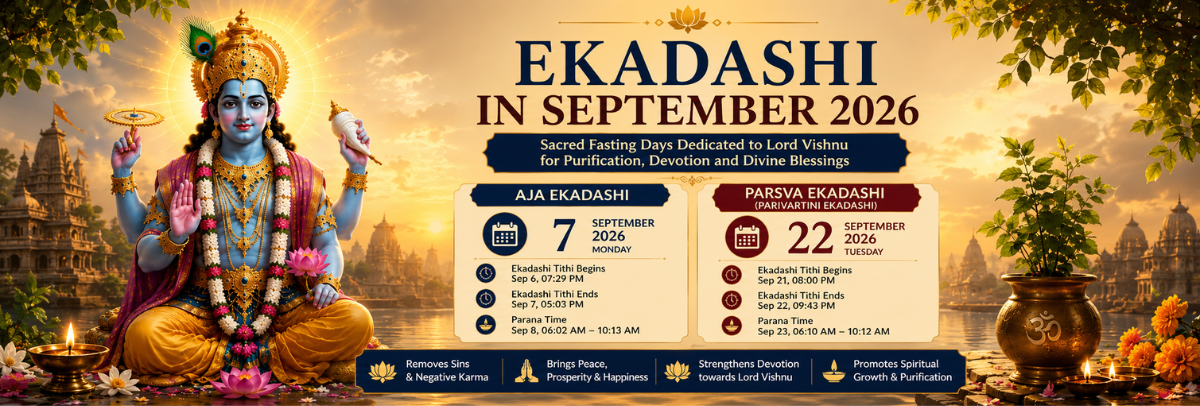
There's something about September in the Hindu calendar. Two Ekadashis fall this month, both offered to Lord Vishnu, and yet if you sit with their stories for a while, you realise they couldn't be more different in spirit. Aja Ekadashi 2026 carries the weight of a king who lost everything for the sake of truth. Parsva Ekadashi, coming a fortnight later, belongs to a quieter moment, the one where Vishnu turns in his cosmic sleep, and it arrives hand in hand with Vamana Jayanti 2026, the day dedicated to Vishnu's dwarf incarnation. So September, for anyone who follows these observances, ends up being a fairly packed month. Let's get the dates out of the way first, since that's usually what people are searching for anyway.


Ekadashi in September 2026: Dates at a Glance


Ekadashi Date Tithi Begins Tithi Ends Parana
Aja Ekadashi 2026 Monday, September 7 September 6, 7:29 PM September 7, 5:03 PM Tuesday, September 8
Parsva Ekadashi 2026 Tuesday, September 22 September 21, 8:00 PM September 22, 9:43 PM Follow the prescribed local Panchang timing


A quick word on parana, in case the term is new to you: it simply means the time at which the fast is broken. These windows shift a little depending on where you are, so it's worth checking your local Panchang rather than relying on a blanket time, especially for Parsva Ekadashi, where the parana depends on regional sunrise calculations.


Aja Ekadashi 2026: Date, Tithi & Significance


Mark your calendar for Monday, September 7. That's when Aja Ekadashi 2026 falls this year, with the tithi beginning the evening before, on September 6 at 7:29 PM, and running through to 5:03 PM on the 7th. The fast is then broken the following day, Tuesday, September 8.


This one lands in the Krishna Paksha, the waning half of the moon, in the month of Bhadrapada. What draws people to the Aja Ekadashi vrat, generation after generation, is the belief attached to it: that a sincerely kept fast on this day can help wash away old mistakes and bring a person closer to Lord Vishnu's grace. It's often spoken of as one of those Ekadashis people turn to when they want, in a sense, to start over.


Aja Ekadashi Katha: The Story Behind the Fast


Every Ekadashi seems to come with a story attached, and this one belongs to King Harishchandra. If the name sounds familiar, it should, he's remembered as perhaps the most truthful king in all of Hindu mythology, and his story is not a gentle one.


Harishchandra had given his word to the sage Vishwamitra, and to keep that word, he gave up everything: his throne, his wealth, eventually even his wife and son. He ended up working at a cremation ground just to get by, and through all of it, through humiliation that would have broken most people, he never once went back on the truth. That was the one thing he wouldn't trade away.


It was during this darkest stretch that a sage advised him to observe Aja Ekadashi. He did, with whatever faith he had left, and the story goes that things slowly began to turn. His family came back to him. His kingdom was restored. Whether one reads this as history or as parable probably matters less than what it's meant to teach: that truth, however costly, eventually finds its way back to grace.


This is the katha that's still read out in homes on the day of the fast, usually in the evening, as a way of holding on to that idea a little longer.


Aja Ekadashi Vrat and Parana


No two households seem to keep this fast in quite the same way, but a rough shape of the day tends to repeat itself. It usually starts before sunrise, with a sankalp, a kind of personal vow to keep the fast with intent rather than out of habit. Grains are set aside for the day. Some people go further and keep a nirjala fast, skipping water altogether, while others follow a phalahari fast, sticking to fruit and a handful of simple foods. Either way, the day is built around worship: flowers and Tulsi leaves offered to Vishnu, a lamp lit, Vishnu mantras chanted through the hours, and the Aja Ekadashi katha read or listened to before the day closes. Many people also make it a point to give something away, a bit of food or money to someone who needs it, since charity is considered as much a part of the vrat as the fasting itself. The fast finally ends the next morning, within the Aja Ekadashi parana window on September 8.


It's worth saying plainly that none of this is meant to be rigid. Health, age, and family custom all shape how strictly someone keeps the fast, and most priests will tell you the same thing: do what your body allows.


Parsva Ekadashi 2026: Date, Tithi & Importance


Two weeks later, on Tuesday, September 22, comes Parsva Ekadashi 2026, also known by an older name, Parivartini Ekadashi. The tithi begins the previous evening, September 21 at 8:00 PM, and runs until 9:43 PM on the 22nd.


This one falls within Chaturmas, the four-month stretch when Vishnu is believed to be in a state of cosmic sleep. Tradition holds that it's on this particular day that he shifts position, turning from one side to the other, which is exactly where the name comes from, Parivartini meaning "the one who turns" or "the one who changes." There's a belief that observing this fast carries the combined merit of several other Ekadashis, which is part of why it's held in such regard.


Parsva Ekadashi and Vamana Jayanti 2026


Here's what makes this particular Ekadashi worth pausing on this year: it shares its date with Vamana Jayanti 2026, the day that marks the birth of Lord Vamana, Vishnu's fifth incarnation.


The story behind it goes back to Mahabali, a demon king whose generosity and devotion had made him almost too powerful, powerful enough to unsettle the balance between heaven and earth. So Vishnu took the form of Vamana, a Brahmin boy of unusually small stature, and appeared before Mahabali during a yagna. He asked for something modest, or so it seemed: just as much land as he could cover in three steps. Mahabali, a man of his word, agreed without hesitation.


What happened next is the part everyone remembers. Vamana grew, and grew, until he was vast beyond imagining. One step covered the earth. The second covered the heavens. And for the third, there was nowhere left to place it, so Mahabali, understanding by now exactly who stood before him, bowed his head and offered it as the final step. Vishnu placed his foot there, sending Mahabali down to rule the netherworld, but not without honouring the humility that had brought him to that moment.


People often read the Vamana avatar as a story about the limits of power and the quiet strength of surrender. Because the two occasions fall so close together, many families observe Parsva Ekadashi and Vamana Jayanti as one continuous thread, fasting on one while reflecting on the other.


Parsva Ekadashi Vrat and Puja


The puja itself doesn't need to be complicated. A sankalp is taken at the start of the day, alongside the fast. Vishnu is worshipped, typically once in the morning and again in the evening, with flowers, Tulsi leaves, fruit, and a simple naivedya, or food offering. Mantras are chanted, and many people spend part of the day reading Vishnu-related scriptures or listening to the Ekadashi katha. As with Aja Ekadashi, charity finds its place here too, and how strictly the fast itself is kept comes down to what a person's body and family tradition allow.


Aja Ekadashi vs Parsva Ekadashi


Feature

Aja Ekadashi

Parsva Ekadashi

2026 Date

September 7

September 22

Deity

Lord Vishnu

Lord Vishnu

Main Association

Redemption and purification

Vishnu's cosmic change of position

Other Name

Aja Ekadashi

Parivartini Ekadashi

Related Observance

Aja Ekadashi vrat

Vamana Jayanti

Fast

Ekadashi fasting

Ekadashi fasting


Why Ekadashi Fasting Matters


Strip away the individual stories, and a few common threads run through both these days. There's discipline in choosing to fast at all, a deliberate stepping back from routine indulgence. There's devotion, the day set aside for prayer rather than the usual rush. There's also, more often than not, an act of giving, some form of charity that turns the fast outward instead of keeping it purely personal. And underneath all of it sits an old, simple idea: that a day of restraint can offer a kind of reset, not in any medical sense, but for the mind and for one's intentions.


FAQs


Q1. When is Aja Ekadashi 2026? 

Ans. It falls on Monday, September 7, with the tithi running from 7:29 PM on September 6 to 5:03 PM on September 7.


Q2. What is the Aja Ekadashi parana time? 

Ans. The fast is broken on Tuesday, September 8. It's best to check your local Panchang for the exact window.


Q3. When is Parsva Ekadashi 2026? 

Ans. Parsva Ekadashi 2026 falls on Tuesday, September 22, with the tithi beginning at 8:00 PM on September 21 and ending at 9:43 PM on September 22.


Q4. What is the connection between Parsva Ekadashi and Vamana Jayanti 2026? 

Ans. The two fall on the same day this year. Vamana Jayanti marks the birth of Lord Vamana, Vishnu's fifth incarnation, and many devotees observe it alongside the Parsva Ekadashi fast.


Q5. What can devotees eat during Ekadashi fasting? 

Ans. Grains are usually avoided. Some keep a nirjala fast without food or water, while others eat fruit and simple phalahari dishes, depending on what they can manage.

You Might Also Be Interested In This