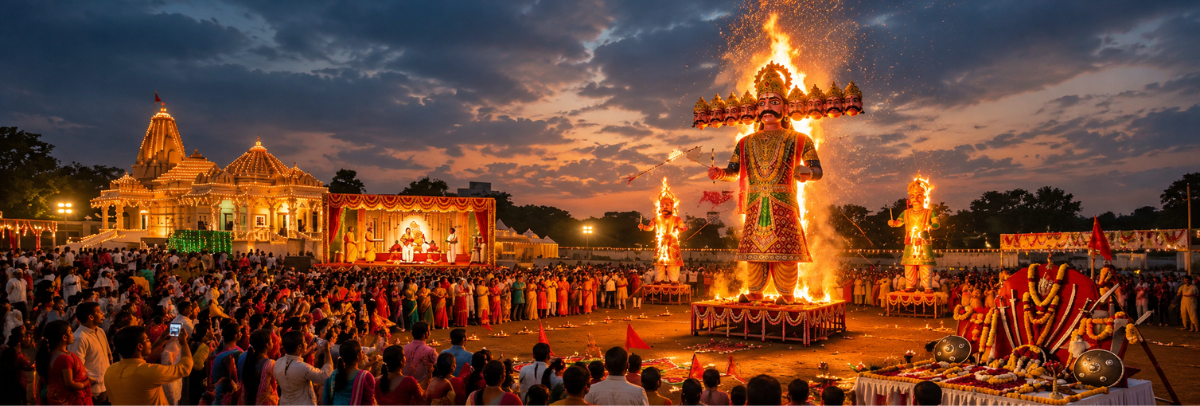
On the final evening of Ramlila, a ground somewhere in North India fills long before the performance begins. Children sit on their fathers' shoulders, vendors sell roasted peanuts, and three towering effigies stand silhouetted against a darkening sky, waiting. Hundreds of kilometres east, in a Kolkata neighbourhood, a different kind of gathering takes shape: women in white-and-red saris prepare to bid farewell to Goddess Durga, who has spent the past days in their midst.
Both scenes belong to the same day. Dussehra 2026, also called Vijayadashami 2026, falls on Tuesday, 20 October 2026 across most of India, while Bengal's Durga Puja calendar places Vijaya Dashami on Wednesday, 21 October 2026. The Dashami tithi begins on 20 October at 12:50 PM and ends on 21 October at 2:11 PM.
The festival carries two names because it carries two stories. Dussehra is the name most often used in North India, where the day is tied to Lord Rama's victory over Ravana. Vijayadashami literally means the tenth day of victory, and it also marks Goddess Durga's triumph over Mahishasura at the close of Navratri. The two narratives sit side by side, and which one a family emphasises depends largely on where they live.
Dussehra 2026 Date and Dashami Tithi
The quick answer to the date question is in this table.
| Occasion |
Date/Timing |
| Dussehra/Vijayadashami |
Tuesday, 20 October 2026 |
| Vijaya Dashami in Bengal |
Wednesday, 21 October 2026 |
| Dashami Tithi Begins |
20 October, 12:50 PM |
| Dashami Tithi Ends |
21 October, 2:11 PM |
The two dates are not a contradiction. Dashami spans parts of both days this year, and regional calendars read that overlap differently. 20 October is the general Dussehra/Vijayadashami date observed in most of the country. 21 October is the Vijaya Dashami date followed by the Bengali Durga Puja calendar, which arranges the closing rituals of the pujas, including the farewell to the goddess, according to its own traditions. If you are planning around a specific community's celebration, it is worth confirming which calendar they follow.
Vijayadashami Muhurat 2026
These timings are for New Delhi.
- Vijay Muhurat: 1:59 PM to 2:45 PM
- Aparahna Puja Time: 1:14 PM to 3:30 PM
- Shravana Nakshatra: 19 October, 3:38 PM to 20 October, 6:02 PM
The Vijay Muhurat is a short window regarded as favourable for starting something with the intention of success, and it is the slot many families aim for when beginning Vijayadashami worship. The Aparahna, roughly the afternoon portion of the day, is the traditional period for much of the day's ritual, which is why Shami and Aparajita worship are usually placed within it. Shravana Nakshatra is the lunar asterism associated with the day in many Panchangs.
Muhurats shift from city to city with sunrise and sunset, so please treat these as New Delhi timings only. Check your local Panchang, or ask your family priest, before performing any time-sensitive ritual.
Dussehra Puja Vidhi: Rituals and Traditions
The Dussehra puja vidhi is not a single fixed ceremony. Households and regions follow different customs, and what one family considers essential, another may not practise at all. The rituals below are the ones most commonly associated with the day.
Shami Puja and Aparajita Puja
During the Aparahna period, many families worship the Shami tree and Goddess Aparajita, whose name means "the unconquered". The Shami tree appears in the Mahabharata tradition as the place where the Pandavas hid their weapons during their year in disguise and retrieved them afterwards. In some regions, people exchange Shami leaves as a gesture of goodwill. The rituals are linked with ideas of victory, protection and fresh starts; they are acts of devotion rather than guarantees of any outcome.
Ayudha Puja or Astra Puja
Ayudha Puja, called Astra Puja in some places, is the worship of the instruments of one's work. Craftspeople bring out their tools, drivers decorate their vehicles, students place their books before the deity, and in some communities weapons are honoured as well. The idea is gratitude: the things that help people earn and create are given a day of their own. It is especially visible in parts of South India, though it is observed in other regions too, and the details vary.
Seema Avalanghan
Seema Avalanghan means crossing the boundary of one's village or settlement. In older custom, rulers and communities would step beyond their borders on Vijayadashami as a symbolic act of victory and expansion, sometimes combined with Shami worship at the edge of the settlement. It is largely a historical and customary practice. Most modern households do not perform it, though traces survive in a few communities.
Ravan Dahan
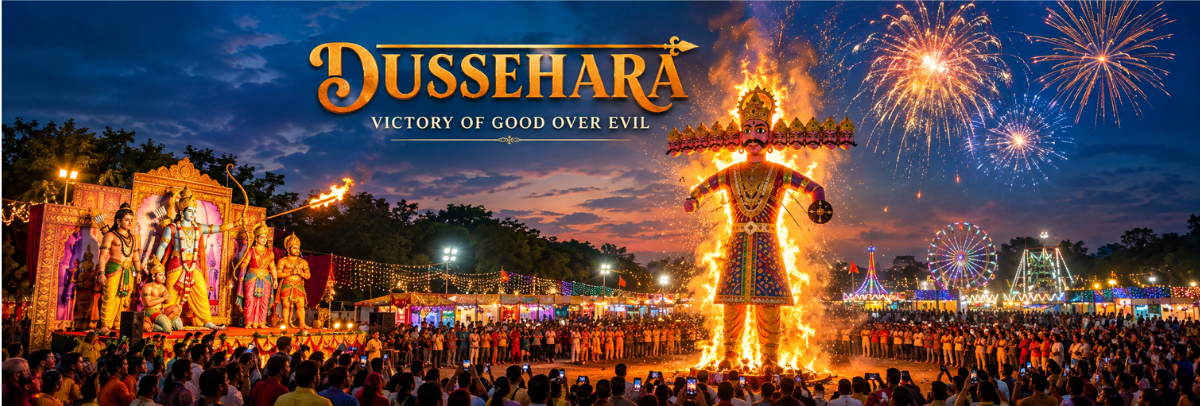
The most recognisable image of the day is Ravan Dahan, when giant effigies of Ravana, his son Meghnad and his brother Kumbhakarna are set alight at dusk in many parts of North India. The crowd usually waits through the final Ramlila scene, in which Rama shoots the arrow that ends the battle, and then the effigies burst into fireworks. The ritual re-enacts the Ramayana's conclusion and stands for righteousness prevailing over wrongdoing. It is not a universal part of Dussehra; many regions mark the day without any effigy burning.
Why Is Dussehra Celebrated? The Significance of Vijayadashami
The idea running through every version of the festival is victory, though different traditions tell it through different figures.
Lord Rama's Victory Over Ravana
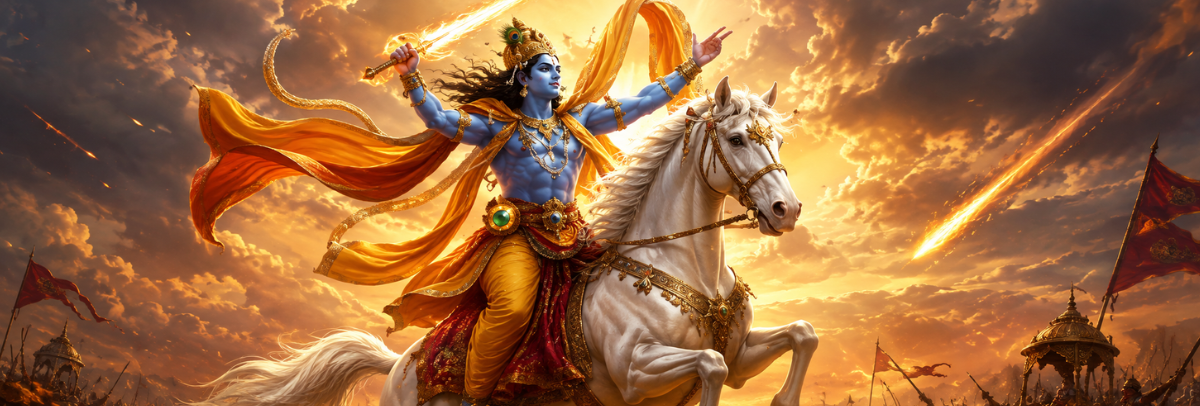
According to the Ramayana, the demon king Ravana abducted Sita and carried her to Lanka. Rama, accompanied by his brother Lakshmana and a vanara army led by Hanuman, travelled south, crossed the sea by building a bridge and fought a long war against Ravana's forces. Ravana was finally defeated, Sita was freed, and dharma was restored. Dussehra is the day when this triumph is remembered, which is why the Ramlila cycle builds towards it.
Goddess Durga's Victory Over Mahishasura
The other major tradition belongs to Goddess Durga. The buffalo demon Mahishasura had received a boon that made him nearly invincible, and the gods, unable to stop him, combined their energies to create Durga. She fought him over nine nights and, on the tenth day, defeated him. This is why Vijayadashami follows directly after the nine nights of Navratri. The two stories are not rivals. They are two accounts of victory attached to the same day, and different regions give each of them prominence.
Dussehra and Navratri: How Are They Connected?
The sequence is simple: Navratri, nine nights of worship, Maha Navami, then Vijayadashami/Dussehra. In many traditions, Vijayadashami is the culmination of Sharad Navratri, the autumn Navratri, and the point at which the goddess's victory is celebrated.
What happens next depends on where you are. Some communities focus on Durga's victory over Mahishasura. Many North Indian traditions centre on Rama's victory over Ravana. Other regions have customs of their own, such as the worship of tools and books. Navratri, Durga Puja and Dussehra overlap, but they are not the same thing: Navratri is the nine-night period, Durga Puja is the particular Bengali-centred festival of the goddess, and Dussehra or Vijayadashami is the tenth day that closes them.
How Dussehra Is Celebrated Across India
North India: Ramlila and Ravan Dahan
In much of North India, Ramlila performances run for days in the lead-up to Dussehra, staged in public grounds and neighbourhood parks, with local actors playing Rama, Sita, Hanuman and Ravana. The final battle draws the biggest crowds, and the evening ends with Ravan Dahan.
Mysuru: Mysuru Dasara
In Karnataka, Mysuru Dasara is a grand state-level celebration with royal roots, centred on the Mysuru Palace. Its best-known sight is the Jamboo Savari, a procession in which the idol of Goddess Chamundeshwari is carried through the city. If you plan to attend, check the official programme closer to the date rather than relying on old schedules.
Kullu: Kullu Dussehra
Kullu Dussehra in Himachal Pradesh follows a different rhythm. It does not rely on the one-day Ravan Dahan format; local deities are brought to the valley in procession, and the celebrations continue for several days, with a character quite unlike the North Indian Ramlila grounds.
West Bengal: Vijaya Dashami
In West Bengal, the day belongs to Durga Puja. Vijaya Dashami, observed here on Wednesday, 21 October 2026, brings the farewell to the goddess: married women apply sindoor to the idol and to each other in a ritual known as Sindoor Khela, and then the idols are carried in procession for immersion, called Durga Visarjan. It is a joyful and emotional occasion at once.
Other Regional Traditions
Elsewhere, the day takes still other forms. In parts of South India, Ayudha Puja and the worship of books and instruments are central, and many families start children's learning on Vijayadashami. The list could go on, which is rather the point: the same date supports very different customs.
Dussehra 2026: A Day for Puja, Reflection and New Beginnings
For most families, the day comes down to a handful of choices. You might hold Vijayadashami puja at home, perform Shami or Aparajita worship during the Aparahna, honour the tools and books you rely on, visit a temple, attend a Ramlila or Ravan Dahan, or take part in your local Durga Puja farewell. In traditions where Vijayadashami is regarded as auspicious, people also begin something new on this day, such as a course of study, an art form or a piece of work. That is a custom of intent and fresh beginnings, not a promise that things will go well, and it is perfectly fine to observe only the parts that matter to your household.
Dussehra 2026 at a Glance
| Detail |
Information |
| Dussehra 2026 |
Tuesday, 20 October 2026 |
| Bengal Vijaya Dashami |
Wednesday, 21 October 2026 |
| Dashami Tithi |
20 October, 12:50 PM to 21 October, 2:11 PM |
| Vijay Muhurat (New Delhi) |
1:59 PM to 2:45 PM |
| Aparahna Puja (New Delhi) |
1:14 PM to 3:30 PM |
| Major traditions |
Ravan Dahan, Shami Puja, Aparajita Puja, Ayudha Puja, Durga Visarjan |
Muhurat timings are for New Delhi and may differ in other cities.
Dussehra 2026: The Meaning of Victory
Back to the two scenes from the start: the crowd watching an effigy of Ravana burst into flames, and the Kolkata neighbourhood watching Durga carried to the water. They look nothing alike, yet both are celebrating a victory. Rama's over Ravana, Durga's over Mahishasura, the burning effigies, the tools laid out for worship in a workshop, the processions in Mysuru and Kullu: each is a different way of marking the same idea. As Dussehra 2026 arrives on 20 October, with Bengal following on 21 October, the festival will look different from one town to the next, and the word at its centre, Vijaya, will be the same.
Frequently Asked Questions
Q1. When is Dussehra in 2026?
Ans. Dussehra/Vijayadashami falls on Tuesday, 20 October 2026 across most of India. In Bengal, Vijaya Dashami is observed on Wednesday, 21 October 2026, following the local Durga Puja calendar.
Q2. What is the Vijay Muhurat for Dussehra 2026?
Ans. For New Delhi, the Vijay Muhurat is 1:59 PM to 2:45 PM on 20 October, within the Aparahna puja time of 1:14 PM to 3:30 PM. Timings differ by location, so check your local Panchang.
Q3. What is the Dussehra puja vidhi?
Ans. It varies by region and family. Common elements include Shami and Aparajita worship in the Aparahna, Ayudha Puja for tools and books, temple visits, and in many places Ravan Dahan in the evening.
Q4. Why is Ravan Dahan performed on Dussehra?
Ans. It re-enacts Rama's defeat of Ravana in the Ramayana and symbolises the victory of righteousness over wrongdoing. It is common in North India but not part of every region's Dussehra.
Q5. What is the difference between Dussehra and Vijayadashami?
Ans. They refer to the same day. Dussehra is the name more common in North India, tied to Rama's victory over Ravana, while Vijayadashami, "the tenth day of victory", also covers Durga's victory over Mahishasura.