There is a particular sound that marks the start of Ganesh Chaturthi in most Indian homes and neighbourhoods — the beat of a dhol somewhere down the street, growing louder as an idol of Ganesha is carried in, garlanded and gleaming, while the family waits at the door with a plate of flowers and sweets. In the days before, the house has already been scrubbed clean, a small wooden platform decorated and readied, and everyone has half an eye on the calendar, working out exactly when to bring Ganpati home.
This year, that moment falls in mid-September. Below, you will find the Ganesh Chaturthi 2026 date, the puja muhurat, a step-by-step sthapana vidhi, and the visarjan dates that mark the festival's close — along with a look at how the celebration actually unfolds, at home and in the streets.
When Is Ganesh Chaturthi 2026?
Ganesh Chaturthi 2026 falls on Monday, 14 September 2026. The festival is timed to the Chaturthi tithi (the fourth day) of the waxing moon in the Hindu month of Bhadrapada, and this year that tithi begins at 7:06 AM on 14 September and runs through to 7:44 AM the following morning, 15 September.
For those installing an idol at home, the recommended window is the Madhyahna Sthapana Muhurat — the midday period considered most auspicious for Ganpati sthapana — which falls between 11:02 AM and 1:31 PM on 14 September 2026.
| Event |
Date/Time |
| Ganesh Chaturthi 2026 |
Monday, 14 September 2026 |
| Chaturthi Tithi Begins |
7:06 AM, 14 September 2026 |
| Chaturthi Tithi Ends |
7:44 AM, 15 September 2026 |
| Madhyahna Sthapana Muhurat |
11:02 AM–1:31 PM, 14 September 2026 |
| Ganesh Visarjan / Anant Chaturdashi |
Friday, 25 September 2026 |
The Madhyahna period is preferred for idol installation because Ganesha is traditionally believed to have been born around midday, which is why this window carries particular weight for sthapana over the morning or evening hours.
What Is Ganesh Chaturthi?
Ganesh Chaturthi is the festival dedicated to Lord Ganesha, the elephant-headed deity regarded as the remover of obstacles and the god invoked before any new undertaking. It is also known as Vinayaka Chaturthi in several parts of the country, particularly across the south, where the same observance is marked under a different name but with much the same spirit.
What makes the festival distinctive is the transformation that happens in ordinary spaces. A living room becomes a temporary shrine, the corner of a courtyard turns into a small stage for daily aarti, and streets that are otherwise unremarkable fill with pandals built specifically to house a community's Ganpati for the duration of the festival. Families who might not gather for weeks at a time make a point of being present for sthapana. Neighbours drop in for prayers. It is less a single ritual and more a stretch of days built around welcoming a guest — one who is treated, quite literally, as a member of the household until it is time for him to leave.
Ganesh Chaturthi 2026 Puja Muhurat
If you are planning the idol installation yourself, the timing to note is the Madhyahna Sthapana Muhurat: 11:02 AM to 1:31 PM on 14 September 2026.
This midday period is considered the most favourable stretch of the day for Ganpati sthapana, and most households and pandal committees plan their installation around it rather than the early morning or evening. Where the day's schedule allows, sticking to this window is the traditional approach, though families naturally work around their own practical constraints when needed.
Ganesh Chaturthi Puja Vidhi: Step-by-Step
The rituals of Ganesh Chaturthi follow a fairly consistent sequence, even though small details vary from home to home.
Clean the Home and Prepare the Altar
The process begins well before the idol arrives, with a thorough cleaning of the house. A wooden chowki or small altar is then set up in a clean, quiet corner — usually the space that will hold the idol for the rest of the festival — and decorated with flowers, rangoli or fresh cloth.
Place the Ganesha Idol
Once the altar is ready, the idol is placed facing east or north, directions traditionally considered favourable for the deity's placement during the festival.
Perform Prana Pratishtha
Prana Pratishtha is the ritual through which divine presence is invoked into the idol, transforming it from a clay or plaster figure into a consecrated form of the deity. It is performed with sacred mantras during the sthapana muhurat, typically led by a priest or the senior-most member of the household who is familiar with the rites.
Make the Offerings
Offerings follow the invocation, and they usually include red flowers, durva grass — a type of grass particularly associated with Ganesha worship — along with modaks and laddoos, both considered his favourite sweets. Each offering carries its own small significance within the ritual, though the details are generally kept simple rather than treated as an exhaustive checklist.
Aarti and Prayers
The puja closes with the lighting of an oil lamp and incense, a round of prayers, and the singing of Ganpati aarti. This becomes a daily routine for as long as the idol remains in the home, usually performed morning and evening.
Why Should You Avoid Looking at the Moon on Ganesh Chaturthi?
One of the more distinctive beliefs associated with this festival concerns the moon. Tradition holds that devotees should avoid looking at the moon on the evening of 14 September 2026, the day of Ganesh Chaturthi itself.
This custom is tied to the idea of Mithya Dosha — a belief that viewing the moon on this particular night can lead to false accusations or unwarranted blame being cast on a person. It is worth being clear that this is a traditional religious belief rather than an established fact, but it remains one of the most searched and widely observed customs of the festival, and many households still take care to avoid it out of habit as much as conviction.
How Long Is Ganesh Chaturthi Celebrated?
Not every household keeps Ganpati for the same length of time. Depending on family custom and regional practice, the idol may stay for 1.5, 3, 5, 7 or 11 days before visarjan.
| Duration |
Visarjan Date |
| 1.5 days |
15 September 2026 |
| 3 days |
16 September 2026 |
| 5 days |
18 September 2026 |
| 7 days |
20 September 2026 |
| 11 days / Anant Chaturdashi |
25 September 2026 |
The 11-day observance concludes on Anant Chaturdashi, which is also the date of the largest and most widely recognised visarjan across the country. Shorter durations are common among households that prefer a more compact observance, while many public pandals and larger community celebrations tend to run the full 11 days.
Ganesh Visarjan 2026: Date & Significance
Ganesh Visarjan is the ritual immersion that brings the period of worship to a close. In 2026, the major visarjan date is Friday, 25 September, which coincides with Anant Chaturdashi.
There is a noticeable shift in mood by the time visarjan arrives. The energy of sthapana — the anticipation, the decorating, the first aarti — gives way to something quieter and more reflective. Processions carry the idol through the streets, often with music and dancing that starts out celebratory, but by the time the idol reaches the water's edge, there is a genuine note of farewell in the air. The belief that carries people through this moment is simple: Ganesha is not leaving for good, but returning next year, and the goodbye is really a "see you again."
How Is Ganesh Chaturthi Celebrated?
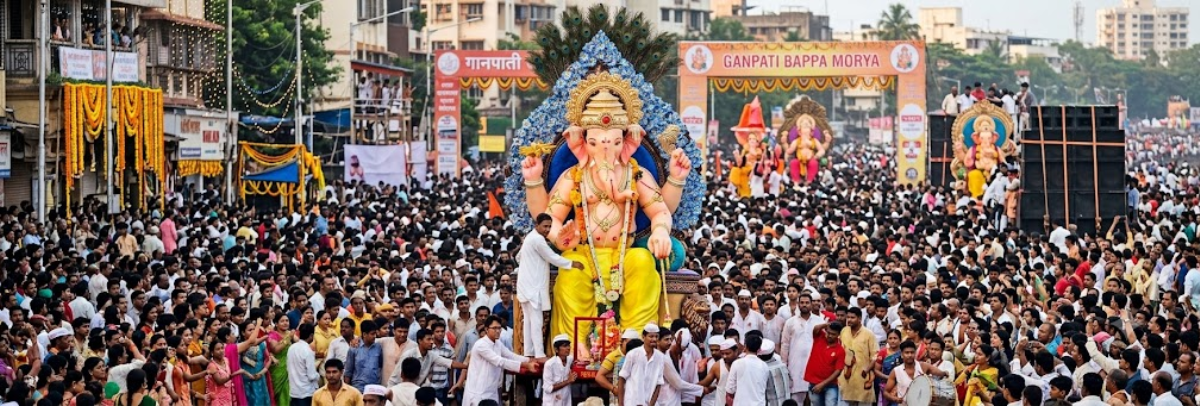
Beyond the home puja, Ganesh Chaturthi takes on a much larger, more public character. Elaborate idols are installed in community pandals, some towering several metres high and drawing visitors from across a city. Streets are strung with lights, and processions for both sthapana and visarjan bring crowds out with dhol players, dancing and chanting.
At the centre of it all is still the puja — daily aartis performed for the community, offerings of modaks distributed among visitors, and prayers that continue on a set schedule for however long the local idol is kept. Families make time to visit multiple pandals over the festival period, treating it as much a social occasion as a religious one.
It is worth noting that the scale and style of celebration can differ quite a bit from one region and community to another — what is standard practice in one city's Ganpati festival might look rather different a few states away, in the length of the celebration, the size of the idols or the specific customs observed.
Ganesh Chaturthi at Home vs Community Celebrations
At home, the festival tends to stay intimate. The focus is on the family's own idol, the daily rhythm of sthapana followed by morning and evening aarti, and the offerings made each day until visarjan. It is a quieter, more personal version of the festival, shaped around a household's own routines and the time family members can give to it.
Community celebrations operate on an entirely different scale. Public pandals often begin planning months in advance, commissioning large idols and elaborate decorations, and organising aartis that draw hundreds of participants rather than a handful of relatives. Processions, cultural programmes and shared meals become part of the experience, and visarjan turns into a citywide event rather than a household ritual. Many people experience both versions in the same festival period — a quiet puja at home in the morning, followed by an evening spent visiting the pandal down the road.
Ganesh Chaturthi 2026: From Sthapana to Visarjan
The festival's shape is really quite simple once you step back from the dates and rituals: Ganesha arrives, is welcomed with prayer and celebration, and is eventually sent off with as much warmth as he was received. This year, that arc runs from the sthapana on 14 September through to visarjan, with households choosing their own point along the way — 1.5 days in, or the full stretch to Anant Chaturdashi on 25 September.
What stays consistent, wherever the celebration lands on that spectrum, is the underlying gesture — clearing a space in the home, in the calendar and in daily life for a guest who is welcomed in fully, celebrated properly, and sent off with the expectation that he will be back next year.
Frequently Asked Questions
Q1. When is Ganesh Chaturthi 2026?
Ans. Ganesh Chaturthi 2026 falls on Monday, 14 September 2026, with the Chaturthi tithi running from 7:06 AM that day until 7:44 AM on 15 September.
Q2. What is the Ganesh Chaturthi puja time in 2026?
Ans.The Madhyahna Sthapana Muhurat, considered the most auspicious window for idol installation, runs from 11:02 AM to 1:31 PM on 14 September 2026.
Q3. When is Ganesh Visarjan 2026?
Ans.The main Ganesh Visarjan falls on Friday, 25 September 2026, coinciding with Anant Chaturdashi.
Q4. How many days is Ganesh Chaturthi celebrated?
Ans.Households observe the festival for varying durations — commonly 1.5, 3, 5, 7 or 11 days — with the 11-day observance concluding on Anant Chaturdashi.
Q5. Why should we not look at the moon on Ganesh Chaturthi?
Ans.Tradition holds that viewing the moon on the evening of Ganesh Chaturthi can bring on Mithya Dosha, believed to invite false accusations. It is observed as a religious custom rather than a scientific claim.